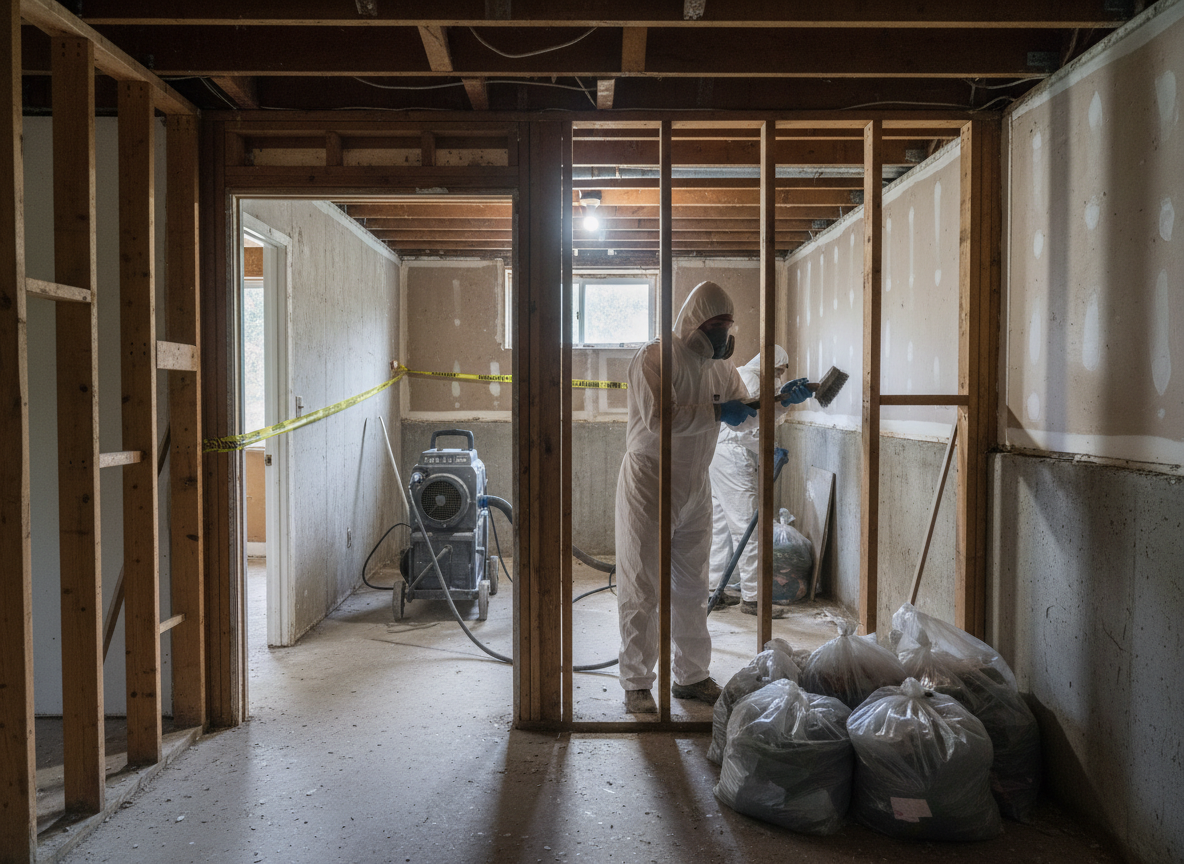
Mount Juliet homes in Providence and Beckwith often see mold after roof leaks or poor drainage around slab foundations common in Wilson County construction from the 1990s onward. Hot summers push indoor humidity above 60 percent, allowing hidden growth behind drywall and in HVAC returns near Providence Marketplace. Remediation requires isolating affected zones with plastic sheeting and negative air machines before removing saturated insulation or carpet padding that traps spores in mild winter dampness.
Commercial spaces along Lebanon Pike face different challenges when floodwater from nearby creeks enters retail or office buildings. Porous materials like acoustic ceiling tiles and vinyl baseboard must be cut out and disposed of to prevent cross-contamination into adjacent suites. Technicians test moisture levels in subfloor plywood and wall cavities with meters before applying EPA-registered antimicrobials, then run dehumidifiers until readings drop below 15 percent to stop regrowth during humid periods.
Edge cases include mold in crawl spaces under older Beckwith properties where soil moisture migrates upward through unsealed vents. These jobs demand full containment tunnels at access points and HEPA vacuuming of joists before encapsulation. Failure to locate the original moisture source, such as a cracked foundation near Charlie Daniels Park, leads to repeat outbreaks within months.
Air sampling before and after work confirms spore counts match outdoor baselines typical for Wilson County. Homeowners in Nashville-commute neighborhoods sometimes overlook HVAC duct cleaning, allowing spores to recirculate into living areas after initial wall repairs.
Technician insight
In Mount Juliet the thing that catches most people out with mold remediation is the way humid subtropical summers keep crawl spaces under 1980s Beckwith homes damp even after the surface leak is fixed, so the job always starts with checking soil contact and grading before any wall work.
Providence Home After Summer Leak
A Providence homeowner noticed musty odors in the master closet after heavy July rain. Inspection showed water had wicked up from a foundation crack into drywall and carpet padding. Crew contained the bedroom, removed the lower three feet of drywall and padding, dried the cavity, and treated joists. Clearance testing passed two days later with no recurrence during the remaining humid season.
Mold Remediation Services Services We Offer
✓Attic Mold Remediation
Remove mold from roof decking and insulation in Providence homes where summer humidity condenses under poor ventilation.
✓Basement Mold Treatment
Extract and treat growth on concrete walls and stored items after groundwater seepage common in Beckwith properties.
✓Post-Flood Mold Cleanup
Address secondary mold following emergency water extraction in commercial buildings near Providence Marketplace.
✓HVAC Mold Removal
Clean and sanitize ductwork and coils where spores travel through systems in Wilson County homes after leaks.
✓Crawl Space Mold Remediation
Encapsulate and treat joists and soil in older Mount Juliet houses where mild winters keep moisture trapped.
✓Moisture Source Identification
Locate hidden leaks in plumbing or grading issues around Lebanon Pike properties before full remediation begins.
Mold Remediation Services Cost in Mount Juliet, TN
| Service | Typical Range | What Affects It |
|---|---|---|
| Small residential area under 100 sq ft | $600–$1,200 | Higher when attic access or HVAC cleaning is needed |
| Basement or crawl space remediation | $1,500–$3,500 | Depends on extent of soil moisture and encapsulation needs |
| Commercial retail space | $2,500–$6,000 | Moves with square footage and after-hours scheduling near Providence Marketplace |
| Air sampling and clearance testing | $250–$450 | Required for insurance documentation in Wilson County jobs |
Ranges are typical for Mount Juliet, TN and confirmed with an exact written quote before any work starts.
How it works
- 1
Inspection and Testing
Walk the property in Providence or Beckwith to map visible growth and use moisture meters on walls and floors affected by local humidity.
- 2
Containment Setup
Install plastic barriers and negative air flow to keep spores from spreading into unaffected rooms during removal.
- 3
Material Removal
Cut out and bag saturated drywall, insulation, and carpet in sections, then HEPA vacuum remaining surfaces.
- 4
Drying and Treatment
Run commercial dehumidifiers and air movers until moisture readings stabilize, followed by antimicrobial application.
- 5
Final Clearance
Retest air and surfaces before removing containment to confirm levels match outdoor Wilson County baselines.
Pricing
Pricing varies by square footage affected, hidden growth discovered during demolition, and whether commercial or residential containment is required.